Archived posts by category: Recipes

foodscout blog
Thursday 27 Aug 2009
Our first harvest: Summer Squash
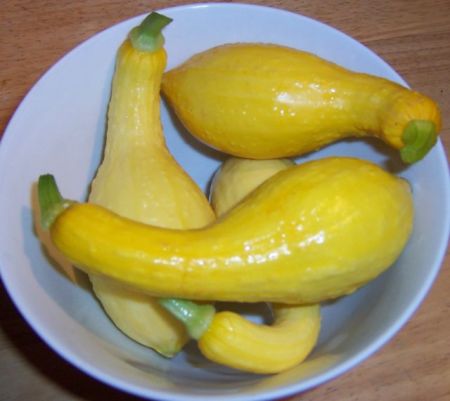 It doesn’t get any fresher than going out to your back yard garden and picking your food for lunch. Yesterday we harvested our first vegetables since planting our garden. 4 Beautiful yellow summer squashes were ready to go.
We are so excited about tasting our own home-grown food that we didn’t do too much with fancy recipes. On the other hand, summer squash is not our favorite food to eat raw because it has a sort of sliminess when you cut it open.
So we enjoyed our squash by slicing it into rounds and steaming them for about 15 minutes. Then we liberally applied nutritional yeast and added a dusting of herbamare (sea salt mixed with herbs). So delicious.
Summer squash from the store is pretty tasty. Summer squash direct from the garden is full of a buttery flavor. Easily the best squash I’ve ever tasted!
At least a couple of dozen more squash vegetables are already forming on our 8 squash plants so we should be enjoying them a few at a time for a while. Next vegetable ready for harvesting will probably be our chard greens.
Friday 13 Jun 2008
Forced creativity through CSAs
 As I mentioned in a recent post, we have joined a Community Supported Agriculture program through which we receive a box full of produce every week. We have no control over what comes in the box. They just give us whatever the farm is growing.
This has been absolutely fantastic. The box is always jam packed full of leafy greens, which accounts for most of the produce that we eat normally. We’ve also found some very fresh cucumbers, tomatoes, and onions in there. But we also get certain items that we don’t eat normally buy, such as beets, radishes, and cabbage.
Since my dad drilled it into my head that wasting food was not an option, I feel compelled each week to finish each and every vegetable in that box. This has forced me to create some dishes that I might never have thought of otherwise.
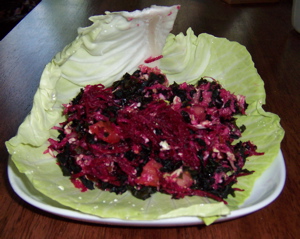
This week, I created something that I will generously call a raw spring roll. The mix of vegetables tasted so good together that I didn’t feel the need to add sauce or seasonings.
2 cups cabbage, shredded
3 small beets, shredded
2 red radishes, shredded
1/4 yellow onion, shredded
1 cup dried seaweed (I used wakame)
1 tomato, chopped
Combine all ingredients and let sit until the seaweed is rehydrated. Wrap inside of whole cabbage leaves and eat. Serves 4.
0 Comments | Posted by Diana | Category: Articles, Recipes
Tuesday 08 Apr 2008
Quinoa and broccoli with “cheesy” sauce
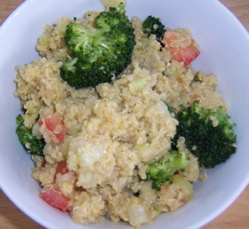 This half-cooked / half-raw concoction has become a favorite of ours during these mild early spring days. It’s super high in those hard-to-get nutrients: Vitamin B-12 from the nutritional yeast, and omega-3s from the flax oil.
1 cup quinoa (before cooking)
1/4 onion, chopped
2 stalks celery, chopped
2 cups broccoli, chopped
1 tomato, chopped
1/4 cup flax oil
1 Tbsp Bragg Liquid Aminos
4 Tbsp nutritional yeast (or more!)
splash of water
sea salt to taste
- Add the quinoa to 2 cups water. Bring to a boil. Add in onions and celery, cover, reduce heat to low and simmer for 20 minutes.
- Mix together flax oil, Bragg Liquid Aminos, and nutritional yeast. Add just a splash of water at a time to thin the mixture, until it is a mustard-like consistency.
- Pour “cheesy” sauce over the broccoli and tomatoes to soften the broccoli while you wait for the quinoa to finish cooking.
- When all the water is absorbed into the quinoa, remove from heat, and mix all ingredients together well.
- Add salt to taste.
Makes 2-3 servings.
3 Comments | Posted by Diana | Category: Recipes
Tuesday 12 Feb 2008
Why are the serving sizes for leafy greens so high?
 When looking up the USDA values for different foods, several options for serving size were available for us to use. We tried to choose serving sizes that align with how much of that type of food the average health-conscious person eats in one sitting.
Leafy greens, such as lettuce, spinach, kale, etc., is an exception to this rule. Most people, including those who eat a healthy diet, do not eat nearly enough greens. Even a big salad only contains 2 or 3 leaves. It may seem like a lot when it is cut up into small pieces and tossed with other veggies and dressing, but it really isn’t.
If we were to set the serving size to what most people actually eat, rather than how much they should eat, you wouldn’t be able to see the rich nutritional content that greens have to offer. All of the serving sizes for our leafy greens pages are set at 100g (with corresponding volume estimates in cups), so that the the nutritional values of the different greens can be easily compared.
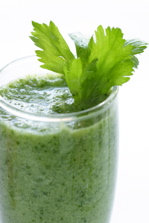
We are strong advocates of the “Green Smoothie,” popularized by raw foodist Victoria Boutenko. Green smoothies are an easy and delicious way to eat all your greens in one meal. We recommend eating a green smoothie every day. Kids love them too!
To make a green smoothie, fill your blender 1/2-way with your favorite fruit and the other 1/2 with greens, and blend. If you are using a regular blender (as compared to a high powered blender like a K-Tec or Vita-Mix) you may want to chop your ingredients up into small pieces before blending. If your smoothie tastes too bitter, add more fruit. Over time, you will likely grow accustomed to the taste of greens and so less fruit will be required.
For more information about green smoothies and some recipes to get you started, check out this nice discussion:
2 Comments | Posted by Diana | Category: Frequently Asked Questions, Recipes